


One Polymer, Many Roles – How Chitosan Is Used Across Modern Medicine and Pharma

Introduction – One Polymer, Many Jobs
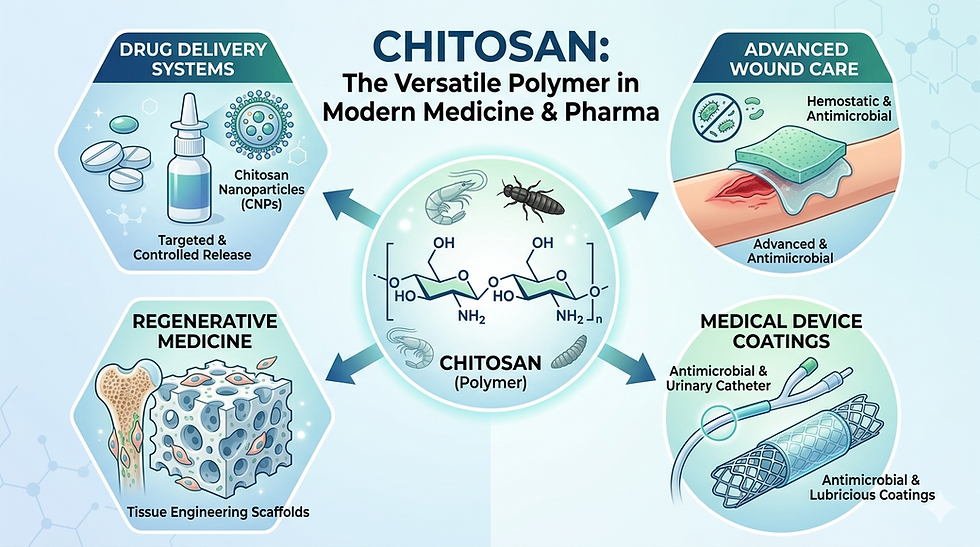
Chitosan has quietly become one of the most versatile polymers in modern life sciences, appearing in oral tablets, transmucosal gels, advanced wound dressings, tissue scaffolds, device coatings and nano‑enabled drug delivery systems. Derived from chitin by partial deacetylation, it combines biocompatibility, enzymatic biodegradability, low toxicity and inherent antimicrobial activity with a rare feature among natural polysaccharides: a cationic backbone that becomes positively charged in mildly acidic environments (de Sousa Victor et al., 2020).
This cationic, mucoadhesive behaviour allows chitosan to interact with mucosal surfaces and biological membranes, opening tight junctions and improving drug transport, while its film‑forming and gel‑forming capacity supports a wide range of solid, semi‑solid and hydrogel formats. Chitosan has long regulatory experience as a food additive (GRAS in the US) and as a component of medical devices and wound dressings, providing a useful precedent for risk assessment and quality expectations (Rajinikanth et al., 2024).
Crucially, chitosan is better viewed as a platform material than a single product: it can be supplied as powders for tabletting excipients, hydrogels and sponges for wound care, porous scaffolds and bioinks for regenerative medicine, and micro‑ and nanoparticles or thin coatings for controlled drug delivery and device functionalisation. For pharma and medtech teams, understanding these families of applications—and what they demand from the underlying polymer—is key to specifying the right grade and de‑risking development.
Chitosan as a Workhorse in Drug Delivery
In conventional oral solid dosage forms, chitosan acts primarily as a multifunctional excipient: it can serve as a binder and disintegrant in tablets, a film former for coatings, and a matrix former in controlled‑release systems. Its ability to hydrate and swell helps disintegration and drug release, while its cationic nature can modulate interactions with acidic drugs or gastro‑intestinal mucosa (Garg et al., 2019; Poonia et al., 2020). For formulators, this offers a way to fine‑tune dissolution profiles and improve robustness without adding synthetic polymers.
Where chitosan really comes into its own is in transmucosal delivery—buccal, nasal, ocular, vaginal and colonic routes—where the goal is to bypass first‑pass metabolism, improve patient convenience, or access local targets. Chitosan’s mucoadhesive properties increase residence time at the mucosal surface, and its ability to transiently open tight junctions can enhance paracellular transport of small molecules, peptides and biologics. In buccal films or gels, this translates into longer contact with the oral mucosa and higher absorption; in nasal formulations, chitosan helps improve brain or systemic uptake via the olfactory and trigeminal pathways (Mura et al., 2022; Zaman et al., 2020).
Chemically modified chitosans—such as thiolated, carboxymethylated or methacrylated derivatives—are increasingly used as “tuned versions” of the base polymer to provide stronger mucoadhesion, in situ gelling, or pH‑responsive release without fundamentally changing the safety profile (Khalaf et al., 2021; de Sousa Victor et al., 2020). For example, thiolated chitosans form disulphide bonds with mucus glycoproteins, giving longer retention, while methacrylated chitosans can be light‑ or chemically‑crosslinked into tailored hydrogels for ocular or vaginal inserts (de Sousa Victor et al., 2020; Mura et al., 2022).
At the nano‑scale, chitosan nanoparticles (CNPs) have become a major focus of drug delivery research and are now entering commercial pipelines . Prepared by ionic gelation, polyelectrolyte complexation or related methods, these polymeric nanoparticles—typically 100–300 nm in size—offer high drug loading, protection of labile actives, and controlled or stimuli‑responsive release. Studies show that CNPs can significantly improve oral bioavailability of poorly absorbed drugs, stabilise peptides and proteins, and support targeted delivery in cancer, inflammatory disease and gene therapy (Mikušová and Mikuš, 2021; Poonia et al., 2020; Ali et al., 2023).
Concrete examples include chitosan‑linked solid lipid nanoparticles designed to deliver fexofenadine specifically to the colon in ulcerative colitis, and intranasal chitosan nanoparticles carrying nalbuphine for rapid, brain‑targeted pain relief (Afzal et al., 2024; El‑Kasaby et al., 2024). Chitosan‑based nanocomposites are also being investigated for rheumatoid arthritis, transdermal delivery of statins and treatment of neurological conditions. Reflecting this momentum, analysts project that the global chitosan nanoparticles market could reach the low single‑digit billions of dollars (around the USD 2–3.5 billion range) by the early 2030s, with strong contributions from pharma and biomedical uses (Market Size and Trends, 2024; Market Statsville, 2025).
Healing from the Outside In: Wound Dressings and Skin Applications

Wound care is one of the most clinically advanced areas of chitosan use, with multiple marketed dressings and haemostatic products already in routine practice (Rajinikanth et al., 2024). Chitosan‑based films, foams, hydrogels, sponges and fibres are used for acute wounds, burns, donor sites, chronic leg ulcers and, importantly, diabetic foot ulcers (Rajinikanth et al., 2024; Yadav and Palei, 2024).
Mechanistically, chitosan supports haemostasis by attracting and aggregating platelets and erythrocytes, and by directly activating platelet receptors, leading to rapid clot formation even in anticoagulated patients. As a dressing matrix, it maintains a moist environment while absorbing exudate, which is critical for optimal healing and patient comfort. Its inherent antimicrobial and anti‑biofilm activity helps suppress common wound pathogens, including resistant strains, reducing infection risk without relying solely on antibiotics (Yadav and Palei, 2024).
Clinical and preclinical evidence shows that chitosan dressings can accelerate re‑epithelialisation, promote angiogenesis and improve collagen organisation, leading to faster closure and better‑quality tissue. Randomised trials in diabetic foot ulcers, for example, have reported markedly higher rates of substantial wound area reduction and limb salvage with chitosan gels compared with standard care (Slivnik et al., 2024). In burns, chitosan dressings have been associated with shorter healing times, reduced pain and improved scar scores (Hu et al., 2023).
From a product‑development perspective, chitosan dressings can also serve as local delivery platforms: antibiotics, antiseptics, growth factors or anti‑inflammatory agents can be incorporated into the matrix for sustained release directly into the wound bed. This combination of barrier function, bioactivity and drug‑elution capability is why many innovators view chitosan as a foundation for next‑generation “smart” wound care products (Frontiers Bioengineering and Biotechnology, 2024).
Building and Repairing Tissues: Chitosan in Regenerative Medicine
In tissue engineering and regenerative medicine, chitosan is used as a scaffold material—often blended with collagen, hyaluronic acid, gelatin or bioactive ceramics—to mimic aspects of the extracellular matrix and support cell adhesion, proliferation and differentiation. Its structural similarity to glycosaminoglycans and ability to be fashioned into porous foams, fibres, hydrogels and 3D‑printed constructs makes it attractive across multiple tissue types (Mariani et al., 2023; Khan et al., 2023).
Chitosan‑based scaffolds have been investigated for skin substitutes, cartilage and meniscus repair, bone grafts, nerve guidance conduits, cardiac patches and dental regeneration. In skin engineering, porous chitosan sponges and nanofibres provide a temporary matrix for keratinocytes and fibroblasts, while in bone applications chitosan is often combined with calcium phosphates to deliver both structural support and osteoconductive cues (Mariani et al., 2023; Sterna et al., 2022). For cartilage and intervertebral disc repair, chitosan hydrogels and cryogels can be tuned for viscoelasticity and degradation rate to match native tissue mechanics (Khan et al., 2023; Rafique et al., 2024).
While only a subset of these applications has reached commercialisation—most notably skin substitutes and some dental and cartilage products—the pipeline is rich (Rafique et al., 2024). Advances in biofabrication and 3D bioprinting are enabling patient‑specific chitosan‑based constructs, and the integration of growth factors, genes or stem cells into chitosan scaffolds is opening new avenues for guided regeneration. For now, much of the work in complex organs (nerve, myocardium, composite tissues) remains pre‑clinical, but the design principles are increasingly well established (Mariani et al., 2023).
On the Surface: Coatings for Medical Devices
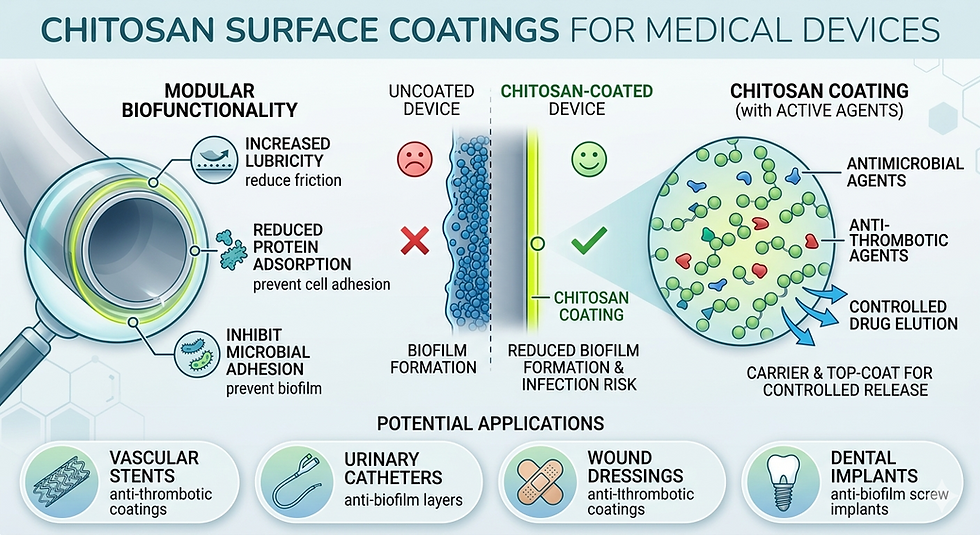
Chitosan is also used as a functional coating on medical devices, where surface properties are critical for safety and performance. As a hydrophilic, cationic polymer, it can be applied as a thin layer on catheters, guidewires, stents, wound dressings, contact lenses and dental devices to improve lubricity, reduce protein adsorption and inhibit microbial adhesion (de Sousa Victor et al., 2020; Mariani et al., 2023).
Antimicrobial chitosan coatings have been shown to reduce biofilm formation and infection risk on indwelling devices, a major driver of hospital‑acquired infections. When combined with antibiotics, antiseptics or anti‑thrombotic agents, chitosan can act as a carrier or top‑coat that releases actives in a controlled manner at the device–tissue interface, without significantly altering bulk device properties (Vega‑Baudrit et al., 2025). Examples under investigation include chitosan‑coated vascular stents, urinary catheters with anti‑biofilm layers, and dental implants with chitosan‑based antimicrobial and osteoconductive coatings (Mariani et al., 2023).
For device manufacturers, chitosan offers a modular way to add biofunctionality—lubricity, antimicrobial action, drug elution—using a single chemistry that can be adjusted via molecular weight, degree of deacetylation and crosslinking (de Sousa Victor et al., 2020).
Nano‑Enabled Futures: Nanochitosan and Nanochitin
Beyond “classic” chitosan nanoparticles, nanochitosan and nanochitin are emerging as a broader family of nanoscale materials with distinct properties (Vega‑Baudrit et al., 2025; Jian et al., 2022). Nanochitin (chitin nanofibres and nanocrystals) provides high mechanical strength, aspect ratio and surface area, while nanochitosan combines these structural advantages with cationic charge and processable chemistry (Jian et al., 2022).
Recent reviews highlight applications of nanochitin and nanochitosan in advanced drug delivery systems, vaccine adjuvants, antimicrobial coatings and wound formulations (Jian et al., 2022). Their high surface area and tunable surface chemistry enable multivalent display of ligands, dense loading of actives, and strong interactions with cells and pathogens, making them attractive for targeted therapies and immunomodulatory strategies. In wound care, nanochitosan fibres and particles can enhance haemostatic and antimicrobial effects while reinforcing mechanical strength of dressings (Vega‑Baudrit et al., 2025).
However, the same nano‑scale features that create opportunity also demand careful attention to safety and regulation. Authors consistently emphasise the need for standardised production methods, robust physicochemical characterisation (size, shape, zeta potential, crystallinity), in‑depth toxicology and clear regulatory pathways tailored to nano‑enabled chitinous materials (Vega‑Baudrit et al., 2025; Jian et al., 2022). As these standards mature, nanochitin and nanochitosan are likely to become increasingly important extensions of the chitin–chitosan platform in pharma and medtech (Vega‑Baudrit et al., 2025).
What Buyers Should Look For in Medical/Pharma Chitosan
For R&D and sourcing teams, matching chitosan grade to application is critical. Key specification themes include molecular architecture, purity, biological safety and processability.
Across all medical/pharma uses
Molecular weight (MW) and distribution: controls viscosity, film‑forming and degradation rates; narrow, well‑controlled MW ranges improve batch‑to‑batch reproducibility (de Sousa Victor et al., 2020).
Degree of deacetylation (DD): higher DD increases cationic charge and solubility in mildly acidic media, enhancing mucoadhesion and antimicrobial activity but also affecting rheology and degradation (de Sousa Victor et al., 2020).
Purity and contaminants: low residual protein, ash and heavy metals, plus tight control of residual acids, solvents and crosslinkers ( P&S Intelligence, 2019).
Endotoxin and bioburden: especially critical for parenteral, transmucosal and implantable products; grades should be supported by appropriate endotoxin limits and sterilisation validation (Rajinikanth et al., 2024; Mariani et al., 2023).
Particulate and fibre burden: relevant for injectables, ophthalmics and device coatings, where visible and sub‑visible particles are tightly regulated (Rajinikanth et al., 2024; Mariani et al., 2023).
By application family
Oral and transmucosal drug delivery: focus on consistent MW/DD for predictable mucoadhesion and dissolution; low endotoxin and residual impurities; excipient documentation and, where possible, pharmacopeial alignment (Garg et al., 2019; Mura et al., 2022).
Nanoparticles and nanochitosan: tight control of particle size distribution and zeta potential; characterisation of encapsulation efficiency and release profiles; documentation of residual crosslinkers, surfactants and solvent traces.
Wound dressings and haemostats: medical‑grade purity, very low endotoxin, robust microbial limits; proven compatibility with chosen sterilisation method (e.g. gamma, EtO, e‑beam) and consistent gel, foam or fibre‑forming performance .
Tissue engineering scaffolds: reproducible porosity and mechanical properties when processed; defined degradation profile; support for combination with other biomaterials and bioactive agents .
Device coatings and combination products: solution viscosity and film‑forming characteristics tailored to coating process; strong adhesion to device substrates; validated elution profiles where actives are incorporated.
Black soldier fly (BSF)–derived chitosan can meet these requirements when processed appropriately, and offers additional advantages: year‑round, land‑based production, reduced reliance on marine shellfish, potential reduction in shellfish allergen concerns and strong ESG positioning (Demianenko et al., 2024). Studies show that BSF chitosan can match or exceed crustacean‑derived chitosan in terms of antimicrobial performance and controllable MW/DD, making it a credible feedstock for pharmaceutical and medical‑grade materials (Lin et al., 2021; Siddiqui et al., 2024). Entoplast specialises in BSF‑derived chitin and chitosan and can supply tailored grades aligned with the specification profiles outlined above for drug delivery, wound care, regenerative medicine and device‑coating projects.
Conclusion – A Platform Material for the Next Generation of Therapies
Chitosan is no longer a niche biopolymer; it is a genuine platform that underpins excipients in oral and transmucosal delivery, advanced wound dressings, regenerative scaffolds, antimicrobial and drug‑eluting device coatings, and an expanding family of nano‑systems. For pharma and medtech innovators, this means one material can address multiple pain points—from bioavailability and infection control to tissue repair and sustainability—provided the right grade and format are chosen .
Entoplast’s BSF‑derived chitin and chitosan portfolio is designed to support this breadth, combining performance, quality and traceability with a sustainable supply chain. If you are exploring where chitosan could plug into your next therapy, medical device or delivery platform, we invite you to discuss your target application and specification needs with the Entoplast team.


Comments