


One Molecule, Many Markets: A Practical Map of Where Chitosan Fits in Different Industries
- Entoplast

- 7d
- 10 min read

Chitosan is a single, highly adaptable molecule that already underpins commercial solutions in sectors from food and agriculture to water, medicine, textiles and energy – and BSF‑derived grades from Entoplast plug into many of the same value chains with a more circular, traceable supply. By treating chitosan as a platform polymer rather than a niche additive, innovation and strategy teams can align multiple business units around one scalable biopolymer backbone.
What chitosan is – and why it is unusual
Chitosan is produced by deacetylating chitin, a structural polysaccharide found in the exoskeletons of crustaceans, insects (including black soldier fly, BSF) and in fungal cell walls. Chemically, it is a linear polymer of D‑glucosamine and N‑acetyl‑D‑glucosamine, and, importantly, it is one of the very few naturally occurring cationic (positively charged) polysaccharides. This cationic character, combined with biocompatibility, biodegradability and low toxicity, underpins its broad industrial use.
Because chitosan carries protonated amino groups in mildly acidic conditions, it binds strongly to negatively charged species (proteins, cell membranes, pigments, metal ions, particulates). It is also film‑forming, gel‑forming and intrinsically bioactive (antimicrobial, hemostatic, antioxidant), making it a true “platform polymer”. Across the literature, chitosan appears in many physical formats: solutions, powders, films, fibres, hydrogels, beads, microspheres, nanoparticles, foams and 3D scaffolds.
Recent cross‑sector reviews emphasise that the same core molecule is now being engineered into applications in food, agriculture, cosmetics, pharmaceuticals, textiles, water, energy and environmental technologies (Wasule and Shinde, 2026). For innovation leaders, the practical question is not whether chitosan has potential, but where it fits your existing and emerging value chains – and what kind of grade or format you actually need.
BSF as a next‑generation source of chitosan

Historically, nearly all commercial chitosan has come from crustacean shell waste, with well‑known constraints: seasonal supply, multi‑country logistics, shellfish allergens and chemical‑intensive extraction. Black soldier fly (Hermetia illucens) offers a complementary route: chitin can be extracted from larvae, pupal shells and adults produced in controlled insect farms that upcycle organic side‑streams.
Studies on H. illucens show that insect‑derived chitosan can match or even outperform crustacean chitosan in antimicrobial, antioxidant and antifungal activities, while remaining biocompatible and suitable for pharmaceutical use (Fusco et al., 2025). Detailed characterisation indicates that BSF chitosan can achieve degrees of deacetylation around 90%, molecular weights in the tens to hundreds of kDa, and film properties comparable to shrimp‑derived grades. Insects can be reared year‑round on traceable feedstocks with lower land, water and greenhouse‑gas footprints than marine harvesting or intensive aquaculture, embedding BSF chitosan in a circular bio‑economy model.
Entoplast focuses specifically on BSF‑derived chitin and chitosan, using green extraction routes and controlled UK production to deliver high‑purity grades with consistent functional performance. This allows the same insect biorefinery to supply protein meals, biofertilisers and high‑value chitosan fractions into multiple markets.
What follows is a practical map of where chitosan already fits – or is starting to fit – across ten industry “domains”.
Food and beverages
Extend shelf‑life, stabilise products and reduce synthetic additives in line with clean‑label and plastic‑reduction goals.
Typical chitosan forms and functions
Edible coatings and films applied to fruits, vegetables, cheeses and meats to slow moisture loss, respiration and microbial spoilage.
Clarifying agents for juices, wines and beers, where cationic chitosan flocculates suspended particles and proteins.
Functional ingredient for fat binding, dietary fibre and encapsulation of flavours or nutraceuticals.
Chitosan‑based coatings and films have been shown to extend the shelf‑life of fresh produce and meat while reducing reliance on synthetic plastic films and preservatives (Stefanowska et al., 2023). These systems often combine chitosan with natural antioxidants or essential oils to deliver both barrier and active antimicrobial effects.
Maturity: Coatings for fresh produce, cheeses and meats and beverage clarification are commercial and scaling, with active packaging films moving from pilot to broader adoption.
Where BSF chitosan can play: BSF‑derived chitosan offers comparable functionality with reduced allergen concerns for shellfish‑sensitive markets, combined with a circular story that aligns with food brands’ sustainability narratives. Entoplast can supply food‑ and packaging‑oriented grades for coatings, films or ingredient systems and co‑develop formulations with partners.
Agriculture and plant health

Boost crop resilience and yield while reducing synthetic pesticides and fertilisers.
Typical chitosan forms and functions
Foliar sprays and seed treatments where chitosan acts as an elicitor, stimulating plant defence responses and enhancing resistance to fungal and bacterial pathogens.
Soil or fertigation additives and nano‑formulations for controlled release of nutrients and agrochemicals, improving nutrient use efficiency.
Film‑forming agents in biostimulant blends that help retain moisture and structure in soils.
Chitosan is widely reported to increase germination rates, root growth, stress tolerance and yield in a range of crops, while reducing disease pressure (Wasule and Shinde, 2026). Chitosan nanoparticles, in particular, are being explored for precision delivery of fertilisers and crop protection agents with lower overall chemical load.
Maturity: Conventional chitosan biostimulants and seed treatments are commercial and scaling; nano‑enabled precision agriculture remains emerging, with significant R&D and early field trials.
Where BSF chitosan can play: BSF chitosan has demonstrated strong antifungal and antibacterial activity, making it suitable for plant health applications, and its production is naturally aligned with agricultural side‑streams. Entoplast can work with agro‑input manufacturers on liquid concentrates, powders or nano‑grade precursors tuned for solubility and activity under field conditions.
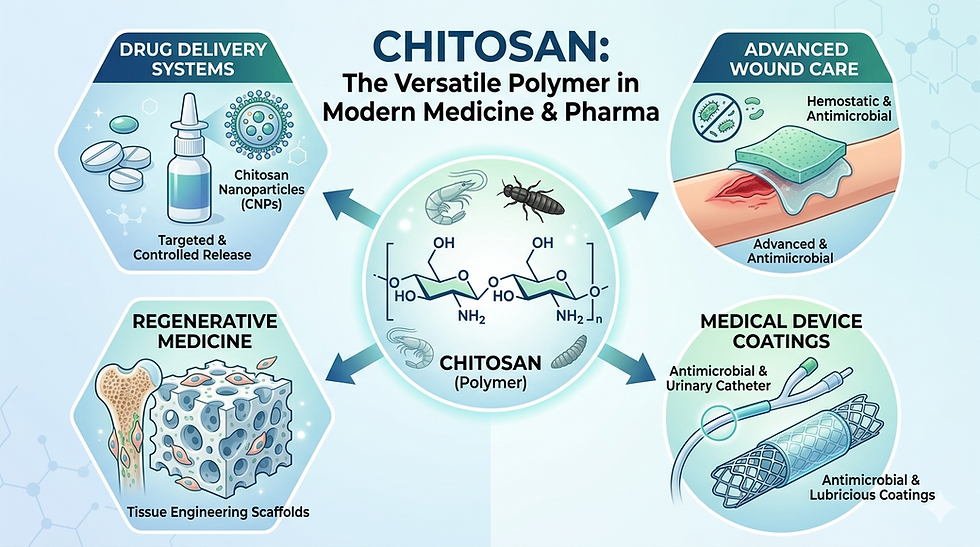
Pharma and biomedicine
Enable safer excipients, advanced wound care and more sophisticated drug‑delivery and tissue‑engineering systems.
Typical chitosan forms and functions
Excipients and mucoadhesive agents in oral, nasal, ocular and pulmonary formulations, exploiting chitosan’s ability to open tight junctions and enhance permeation.
Nanoparticles, micelles and hydrogels for controlled release of small molecules, peptides, proteins and nucleic acids.
Hemostatic dressings, sponges and 3D scaffolds for wound healing and tissue regeneration, leveraging chitosan’s hemostatic, antimicrobial and cell‑interactive properties.
Regulatory bodies have already approved certain chitosan‑based materials for wound dressings, and chitosan nanoparticles are now widely explored as platforms for vaccines, cancer therapeutics and gene delivery (Cheung et al., 2015; Shariatinia, 2018). Insect‑derived chitosan from H. illucens has recently been shown to be non‑toxic to human keratinocytes and to significantly down‑regulate key pro‑inflammatory cytokines, supporting its use as an immunomodulatory biomaterial (Fusco et al., 2025).
Maturity: Wound dressings, haemostats and some excipient uses are mature; advanced drug‑delivery, cell‑instructive scaffolds and smart “responsive” biomaterials are emerging but fast‑moving.
Where BSF chitosan can play: BSF chitosan’s demonstrated antimicrobial and anti‑inflammatory activities, combined with traceable production, make it attractive for next‑generation wound and delivery systems where source and sustainability matter. Entoplast can tailor degree of deacetylation, molecular weight and purity to meet specific pharmacopeial and processing requirements and is open to co‑development with medtech and pharma partners.

Cosmetics and personal care
Provide mild, bio‑based film formers, conditioners and carriers that fit “natural” and “clean beauty” narratives.
Typical chitosan forms and functions
Film‑forming agents in skin, hair and nail products, improving feel, substantivity and wash‑off resistance.
Cationic conditioners in haircare, where chitosan adheres to negatively charged hair surfaces, reducing friction and enhancing shine.
Carriers for active ingredients (e.g. vitamins, plant extracts, UV filters) in nanoparticles, gels or emulsions.
Hydrophilic and quaternized chitosan derivatives have been specifically developed for improved water solubility and performance in cosmetic systems (Bui et al., 2022). Reviews highlight applications in moisturisers, anti‑ageing formulations, sunscreens and deodorants, leveraging chitosan’s film‑forming, antimicrobial and sensory properties.
Maturity: Use as a film‑former, thickener and conditioning agent is commercial; more advanced delivery and “active” cosmetic systems are scaling.
Water and environmental treatment
Remove particulates, organic matter, dyes and heavy metals from drinking water, wastewater and industrial effluents using safer, biodegradable agents.
Typical chitosan forms and functions
Coagulant/flocculant in place of, or alongside, aluminium and iron salts, aggregating suspended solids and natural organic matter.
Adsorbent beads, fibres or composites for binding heavy metals (e.g. Ni, Cu, Cd, Pb), dyes and other pollutants.
Support material for immobilising enzymes or microorganisms in bioreactors.
Chitosan’s cationic charge and chelating capacity make it an effective “magnet” for negatively charged contaminants and metal ions, and numerous studies report high removal efficiencies for heavy metals and dyes across pH ranges relevant to wastewater treatment. BSF‑derived chitosan has shown high adsorption capacities for metals such as iron and copper from contaminated waters, comparable to or exceeding traditional chitosan products.
Maturity: Municipal and industrial water applications using chitosan flocculants/adsorbents are commercial but still niche, with growth driven by tightening regulation and green‑chemistry procurement.
Where BSF chitosan can play: Entoplast’s BSF chitosan adds circularity (upcycling organic waste), local UK supply and reduced chemical footprint in extraction compared to conventional shell‑based routes. Grades can be tuned for charge density, particle size and crosslinking to fit existing dosing and filtration infrastructure.
Packaging
Replace or reduce fossil‑based plastics and integrate active functionality (antimicrobial, antioxidant, barrier) into packaging.
Typical chitosan forms and functions
Stand‑alone films produced by casting or extrusion, sometimes blended with starch, cellulose or other biopolymers.
Coatings on paper, board or plastic substrates to add oxygen and grease barriers and antimicrobial activity.
Active packaging systems where chitosan matrices carry natural antimicrobials or antioxidants to extend food shelf‑life.
Chitosan‑based films are biodegradable, bio‑functional and exhibit good oxygen barrier properties, especially at low humidity, while natural additives can further strengthen antioxidant and antimicrobial performance (Stefanowska et al., 2023). Reviews identify chitosan as a leading candidate for bio‑based active packaging, although large‑scale industrial adoption still faces cost, processing and performance standardisation challenges.
Maturity: Niche and regional packaging applications are commercial; large‑scale replacement of commodity plastics remains emerging and dependent on regulation and consumer pull.
Where BSF chitosan can play: Packaging brands increasingly scrutinise upstream impacts of “bio‑based” materials; BSF‑based chitosan enables credible circular‑economy and non‑marine sourcing claims alongside technical performance. Entoplast can support converters and brands with film‑grade and coating‑grade materials tailored for specific converting routes.
Textiles and paper

Add functionality and performance (e.g. antimicrobial, antistatic, strength, barrier) while reducing persistent chemicals.
Typical chitosan forms and functions
Textile finishes imparting antimicrobial, deodorising, UV‑protective or easy‑care properties.
Dye‑fixing agents that improve colour fastness and reduce dye run‑off.
Paper and board strength agents, wet‑end additives and surface treatments to enhance dry strength, water resistance and printability.
A recent review of chitosan applications in textiles and paper highlights its use as a polycationic finish in cotton, wool and synthetic blends, and as an additive to improve paper strength and water resistance while enabling biodegradable packaging and specialty papers (Wasule and Shinde, 2026). Chitosan can also help retain fillers and fines in paper furnish, reducing raw‑material losses.
Maturity: Antimicrobial and easy‑care textile finishes and paper strength agents are commercial but specialised; broader adoption is scaling as brands push for PFAS‑free and formaldehyde‑free chemistries.
Where BSF chitosan can play: For mills and brands with sustainability targets, BSF‑derived chitosan offers traceable, non‑marine sourcing and alignment with circular‑economy narratives. Entoplast can supply textile‑ and paper‑grade chitosan with defined viscosity and charge to integrate into existing finishing and wet‑end systems.
Energy and “electro” applications
Provide affordable, sustainable ion‑conducting membranes and functional layers in electrochemical devices and sensors.
Typical chitosan forms and functions
Anion‑exchange membranes (AEMs) for alkaline fuel cells, where chitosan is chemically modified to carry fixed cationic sites and form hydrated, ion‑conducting films.
Solid electrolytes and gel electrolytes in batteries and supercapacitors.
Functional layers and binders in dye‑sensitised solar cells and electrochemical sensors.
Chitosan‑based AEMs have shown promising hydroxide conductivity, mechanical stability and alkaline durability, positioning them as eco‑friendly alternatives to fluorinated membranes in certain fuel‑cell architectures (Teli et al., 2022). Reviews also describe chitosan’s use in solid‑state batteries and energy‑harvesting systems due to its ability to form ionically conductive networks when doped with acids or salts.
Maturity: These uses are emerging to early‑stage, mainly at lab and pilot scale; commercial deployment remains limited to niche devices.
Where BSF chitosan can play: For energy‑storage and fuel‑cell developers under pressure to decarbonise supply chains, BSF‑origin chitosan brings a stronger sustainability narrative without changing the underlying polymer chemistry. Entoplast can collaborate with research and industrial partners on membrane and electrolyte grades engineered for reproducible performance.

Advanced materials and nanotechnology
Create smart, responsive and multifunctional materials for high‑value applications.
Typical chitosan forms and functions
Nanoparticles, nanofibres and nanofilms serving as carriers, reinforcing phases or functional interfaces in composites.
Smart hydrogels and shape‑changing materials that respond to pH, temperature, ionic strength or biological signals.
Nanocomposites with inorganic fillers (e.g. clays, oxides, metals) for improved mechanical, barrier, optical or electrical properties.
Polysaccharide‑based nanosystems reviews highlight chitosan’s role across active nanofilms, scaffolds and bio‑nano composites, particularly in biomedical and sensing contexts. Chitosan‑based “smart” biomaterials are being engineered to release drugs in response to specific stimuli, guide cell behaviour or change properties in situ (Nguyen et al., 2023).
Maturity: Largely emerging, with strong academic and early industrial activity in medical devices, diagnostics and high‑value coatings.
Where BSF chitosan can play: In advanced materials, polymer purity, structure and reproducibility are critical; BSF‑derived chitosan from controlled insect farming and modern extraction provides a stable platform for sophisticated chemistries. Entoplast can support nanomaterials developers with well‑characterised, application‑specific feedstocks.
BSF‑anchored circular bio‑economy
Chitosan is not just another product: it is the highest‑value fraction that can plug into many of the markets described above. BSF‑derived chitosan can be channelled into agriculture (biostimulants), food and packaging (coatings, films), water treatment, cosmetics, biomedical materials and advanced composites from the same upstream biomass. Entoplast is positioned within this insect biorefinery model as the specialist BSF chitin/chitosan partner, able to co‑develop grades that let different business units within a customer organisation share a common, circular biopolymer backbone.
How to think about chitosan in your pipeline
For innovation and strategy teams, three practical questions help decide where chitosan – and specifically BSF‑derived chitosan – fits:
What is the primary job‑to‑be‑done?
Is it binding (e.g. coagulant, dye fixer), forming barriers (films, coatings, membranes), delivering actives (nanoparticles, hydrogels) or interacting with biology (wounds, plants, microbiota)? Different functions imply different grades and formats.
What maturity level do you need?
If you require immediate impact, focus on mature and scaling domains (water treatment, agriculture, wound care, food coatings, textiles/paper). For strategic bets, explore emerging energy, smart materials and advanced biomedical uses where chitosan is already a core material in the literature.
What sustainability and sourcing story are you targeting?
If decoupling from fisheries, local sourcing or circularity are important, BSF‑derived chitosan from a partner like Entoplast provides clear differentiation while remaining compatible with existing chitosan know‑how and IP.
By treating chitosan as a platform polymer and BSF as a modern, circular feedstock, companies can align multiple innovation threads – from crop protection and packaging to wound care and water – around one versatile, bio‑based molecule.


Comments