


Peel Away The Plastic: Chitosan as a Biodegradable Barrier Coating for Paper and Cardboard Packaging


The Hidden Plastic Crisis in Paper Packaging
Every year, billions of paper cups, food cartons, and cardboard boxes arrive at recycling facilities, but the vast majority never actually get recycled. The culprit? A thin layer of plastic bonded to the paper—polyethylene (PE) coatings that have become invisible infrastructure in global packaging systems. These PE-lined paper substrates are fundamental to modern food service and food packaging: they provide the moisture and grease barriers essential to protect products in transit, on shelves, and in consumers' hands. Yet they create an intractable problem: PE cannot be separated from paper during recycling or composting, rendering the entire package unusable at end of life.
The regulatory and market pressure converging in 2025–2026 has made this hidden plastic problem urgent. The European Union's Packaging and Packaging Waste Regulation (PPWR, in force 11 February 2025) mandates that all packaging on the EU market must be recyclable by 2030. Simultaneously, the EU ban on per- and polyfluoroalkyl substances (PFAS) in food-contact packaging takes effect 12 August 2026, eliminating another common barrier coating (Rutkowska-Subocz, 2026). The UK's Extended Producer Responsibility (EPR) schemes and major brand commitments to plastic-free packaging are adding market pressure. For packaging manufacturers, food brands, and food service operators, the time to transition from PE and PFAS is now—but viable alternatives have been elusive. Traditional biodegradable alternatives like polylactic acid (PLA) are themselves classified as plastics under the Single Use Plastics Directive (SUPD) and do not support true recyclability in conventional paper streams (Angelovska-Stankov, 2025).
Enter chitosan—a biopolymer derived from chitin—which offers a genuinely different solution: a fully biodegradable, compostable, and pulp-recyclable barrier coating that can replace PE linings while adding antimicrobial functionality that PE cannot provide.
Why PE-Lined Paper Is a Packaging Dead End

Polyethylene coatings were the pragmatic choice when they were introduced decades ago: they are hydrophobic, heat-sealable, and cost-effective. Today, they are an environmental liability. In the EU alone, an estimated 36–44 million tonnes of paper and cardboard are generated annually, with a significant proportion coated with PE or similar synthetic barrier films. When these packages reach end-of-life, three pathways exist—none satisfactory:
Recycling contamination: PE-coated paper contaminates paper recycling streams. PE does not dissolve or disperse during pulping; instead, it forms sticky masses that damage sorting equipment and reduce the quality of recycled fibre, forcing the entire bale to be diverted to landfill or incineration (From Compliance to Circularity, 2025).
Non-compostability: PE is not compostable in industrial composting facilities. It persists and fragments into microplastics, contributing to both soil microplastic pollution and persistent contamination of compost products (Bunzl Catering, 2018).
Persistent waste: Without viable end-of-life routes, PE-lined packaging accumulates in landfills, contributing to methane emissions and long-term environmental persistence. The hidden plastic is effectively permanent plastic waste.
The financial consequences of this system are materialising rapidly. Under PPWR and UK EPR, producers and importers bear extended responsibility for packaging waste management, including costs for disposal, recycling infrastructure investment, and reporting compliance. Non-recyclable packaging is becoming a liability, not an asset.
Chitosan: A High-Performance Biodegradable Alternative

Chitosan is a linear polysaccharide derived from chitin through deacetylation. Its unique chemistry—a chain of D-glucosamine and N-acetyl-D-glucosamine units with a positive charge in acidic pH—confers multiple functional properties ideal for food packaging barriers. Unlike PE, chitosan is fully biodegradable in both industrial composting facilities and natural environments. Critically, unlike PLA, chitosan does not trigger plastic classification under the SUPD; it is recognised as a naturally derived biopolymer suited to plastic-free packaging claims.
Barrier Performance
Recent research demonstrates that chitosan-based coatings achieve barrier performance comparable to or exceeding PE-lined paper:
Moisture resistance: A dual-layer chitosan–zein coating achieved a Cobb 60 value (water absorption) of 4.88 g/m², comparable to or superior to conventional PE-coated paperboard, which typically ranges from 5–8 g/m² (Food-Safe Chitosan–Zein Dual-Layer Coating, 2020).
Grease resistance: The same chitosan–zein formulation achieved a kit rating of 12/12 for oil resistance, meeting and exceeding the demanding FDA standards for grease-resistant food packaging. More recent fully bio-based chitosan–genipin–microfibrillated cellulose (MFC) composites achieve 12/12 kit ratings at remarkably low coating weights of just 4 g/m², compared to 8–12 g/m² for conventional PE coatings (Fully Bio-Based Grease Resistant Composite Coating, 2025).
Oxygen barrier: Crosslinked chitosan multilayer coatings reduce oxygen transmission rates (OTR) by 36× compared to uncoated PET in high-humidity environments, extending shelf life for oxygen-sensitive products and demonstrating that chitosan's barrier performance can be tuned through crosslinking and layer architecture (Simone et al., 2019).
Recyclability and Compostability
The defining advantage of chitosan over PE and PLA is its dual end-of-life pathway:
Pulp recyclability: Chitosan-coated paper can be successfully repulped and reprocessed within conventional paper recycling streams. During pulping, chitosan disperses with other organic components rather than contaminating the fibre stream. Multiple studies confirm successful fibre recovery and recyclability validation according to industry standards (PTS method PTS-RH 021/97 cat II) (From Compliance to Circularity, 2025; Food-Safe Chitosan–Zein Dual-Layer Coating, 2020).
Industrial and home compostability: Chitosan is fully biodegradable. EN 14995 and similar international compostability standards classify chitosan-coated paper as compostable, breaking down to carbon dioxide, water, and organic residues without leaving microplastics or persistent residues (Sustainable Coating Paperboard Packaging Material Based, 2023).
Antimicrobial Active Benefit
Unlike PE, chitosan provides intrinsic antimicrobial activity. At the pH conditions of food packaging (typically acidic), chitosan's amino groups become protonated, creating positive charges that disrupt bacterial and fungal cell membranes through electrostatic interaction. This active benefit extends shelf life, reduces microbial spoilage, and can reduce reliance on chemical preservatives—a significant advantage for clean-label and natural product claims (Chitosan Edible Films and Coatings, 2022).
Formulation and Industrial Scale
Chitosan barrier coatings are compatible with established paper coating equipment and can be applied at scale using proven methods:
Solution coating: Chitosan solutions at 0.5–2 wt% can be applied via curtain coating, slot die, or spray application on paper coating lines, with drying via conventional air or infra-red dryers.
Composite approaches: Chitosan is most effective when combined with hydrophobic biopolymers (zein, proteins) or crosslinking agents (genipin, tannic acid) to optimise moisture and grease resistance. Chitosan–zein dual-layer systems represent the current state-of-the-art, achieving both water and oil barriers at practical coating weights.
Pulp moulding integration: For rigid packaging (food trays, cups), chitosan can be integrated into the pulp mould formulation, creating inherently barrier-functional packaging without post-process coating.
The scalability is proven: industrial trials at paper mills have validated chitosan coating application at commercial speeds and volumes, with no requirement for capital equipment redesign.
Regulatory Context and Timeline
The regulatory backdrop is driving urgency:
PPWR (EU 2025/40): Entered into force 11 February 2025; full compliance required from 12 August 2026. Mandates that all packaging on the EU market must be recyclable by 2030. PE-lined paper does not meet recyclability criteria.
PFAS ban (PPWR Article 5): Effective 12 August 2026, PFAS concentrations in food-contact packaging are restricted to 25 ppb (non-polymeric), 250 ppb (combined), or 50 ppm (polymeric) unless already restricted. This eliminates grease-resistant fluoropolymer coatings widely deployed in paper packaging.
Single Use Plastics Directive (SUPD) and plastic classification: PLA and other synthetic polymeric coatings are classified as plastic under SUPD, conflicting with "plastic-free" positioning. Chitosan, as a naturally derived biopolymer, does not trigger this classification, aligning with regulatory and brand plastic-free commitments (McKinsey, 2025).
The coated packaging paper market is substantial—valued at $2.39 billion in 2024 and projected to reach $3.34 billion by 2032 (coated-packaging-paper market CAGR ~5%). Sustainability is now a top priority for packaging purchasers across FMCG, food service, and retail (McKinsey, 2025). Chitosan-coated alternatives position converters and brands as regulatory leaders.
BSF-Derived Chitosan: The Circular Solution
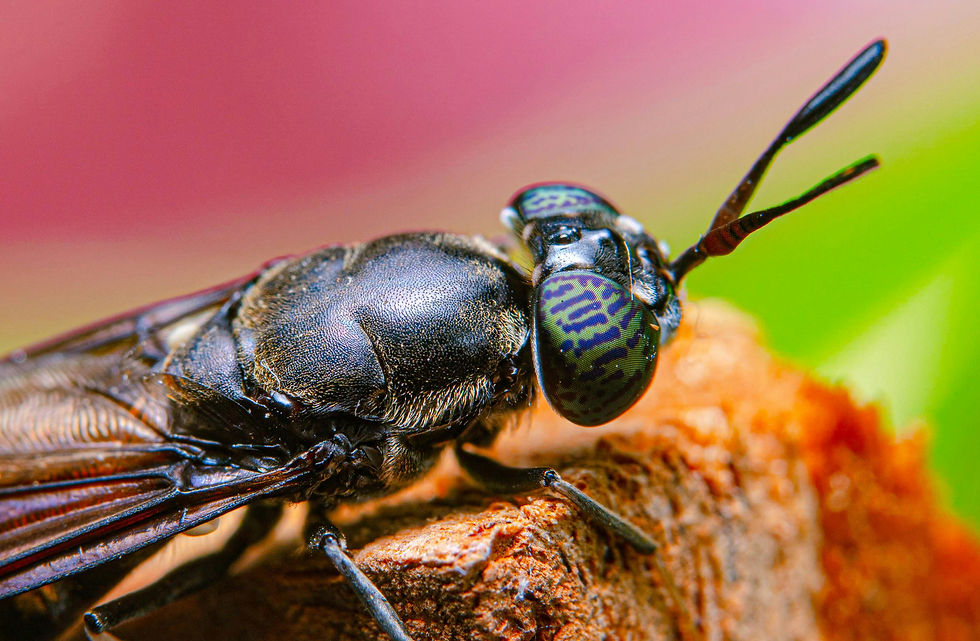
For packaging manufacturers seeking chitosan, the source matters. Black Soldier Fly (BSF) derived chitosan offers distinct advantages over traditional crustacean-derived sources:
Circular sourcing: BSF larvae convert organic waste (food scraps, agricultural residues) into biomass efficiently. Chitin extraction from BSF does not rely on marine fishing, eliminating ecosystem pressure and supporting organic waste valorisation.
Allergen-free and shellfish-free: BSF chitosan contains zero shellfish proteins and does not trigger shellfish allergen concerns—a critical advantage for food-contact applications where cross-contact contamination could pose regulatory and commercial risk (Chitosan Global, Black Soldier Fly Chitosan, 2015; Shield Nutraceuticals, 2024).
Traceable, consistent supply: Land-based BSF farming provides stable, auditable supply chains with full traceability and documented batch specification, supporting regulatory documentation and IPP (Product Information File) requirements.
Food-contact grade certification: BSF-derived chitosan can be sourced at food-contact purity levels with full EFSA and FDA food-contact material compliance documentation, eliminating regulatory uncertainty for packaging converters.
Entoplast, as a UK-based BSF chitosan manufacturer, specialises in food-contact grade chitosan optimised for barrier coating applications. We offer technical support, regulatory guidance, and co-development partnerships to enable packaging manufacturers and brands to transition from PE and PFAS to chitosan-coated alternatives rapidly.
Conclusion: The Time Is Now
The convergence of regulatory deadlines, market pressure, and proven technology creates a critical opportunity. PE-lined and PFAS-coated paper packaging will no longer be compliant or competitive by 2026. Chitosan barrier coatings offer a genuine alternative—high-performance, fully biodegradable, pulp-recyclable, and aligned with circular economy principles and brand commitments to plastic-free packaging.
For packaging manufacturers, food brands, and food service operators, the transition is not optional; it is strategic. The companies that move first to chitosan-based barrier solutions will lead the market, secure supply chains, and meet regulatory requirements ahead of competitors caught in compliance crises.
Entoplast is committed to supporting this transition. Our BSF-derived, food-contact grade chitosan provides the raw material foundation for truly sustainable, recyclable, and compostable paper packaging. We offer technical consultation, performance data, regulatory documentation, and co-development support to help packaging converters, FMCG brands, and food service operators develop and commercialise chitosan barrier coating solutions.
The plastic hidden in paper packaging must be peeled away. Chitosan makes that transition possible today.
Contact Entoplast to discuss chitosan barrier coating grades, technical specifications, regulatory documentation, and co-development opportunities.


Comments