


Chitosan Bioinks in Cartilage and Tendon Repair: 3D Printing the Body's Toughest Tissues


Articular cartilage and tendons are among the most mechanically demanding tissues in the body, yet they exhibit minimal intrinsic capacity for repair once damaged (Steinmetz et al., 2023; Wu et al., 2021). Osteoarthritis affected an estimated 595 million people worldwide in 2020 and is projected to approach one billion by 2050, while degenerative and traumatic tendon disorders such as rotator cuff tears and Achilles tendon ruptures are similarly prevalent and debilitating (Steinmetz et al., 2023; Briggs Price et al., 2024). Standard surgical options, including autografts, allografts, sutured repairs and synthetic grafts, often fail to restore native structure and function and are associated with donor site morbidity, re-tear and progressive degeneration (Wu et al., 2021; Hu et al., 2023).
Three-dimensional (3D) bioprinting has emerged as a powerful platform to fabricate patient-specific, cell-laden constructs with controlled architecture, enabling more faithful recapitulation of cartilage and tendon microenvironments (Wu et al., 2021; Han et al., 2021). Among candidate biomaterials, chitosan, a cationic polysaccharide structurally similar to glycosaminoglycans (GAGs), offers a particularly attractive backbone for musculoskeletal bioinks (He et al., 2020; Ching et al., 2021). When produced from Black Soldier Fly (BSF) chitin with tightly controlled molecular weight and degree of deacetylation (DDA), chitosan provides a high-purity, sustainable feedstock for next-generation cartilage and tendon bioprinting (Kumar et al., 2024).
Why Cartilage and Tendon Are So Difficult to Regenerate
Articular cartilage is avascular, aneural and alymphatic, with sparsely distributed chondrocytes that exhibit very low turnover, so partial-thickness lesions rarely heal spontaneously (Han et al., 2021). It displays a depth-dependent zonal architecture: a collagen-rich superficial zone for lubrication, a proteoglycan-rich middle zone for compressive support, and a calcified deep zone anchored to subchondral bone. Native aggregate compressive moduli are typically in the 0.3 to 1 MPa range, with pronounced tension-compression non-linearity and orthotropic behaviour that are challenging to reproduce with conventional hydrogels (MIT, 2003; Wong & Sah, 2010).
Tendons are highly anisotropic, fibre-dominated tissues that must transmit large tensile loads with minimal elongation. Their hierarchical organisation, from collagen fibrils to fibres, fascicles and whole tendon, yields tensile strengths on the order of 50 to 150 MPa and elastic moduli of 1 to 3 GPa in healthy human tissue (Burr et al., 2017). Like cartilage, tendons are relatively hypovascular and heal by forming scar tissue with inferior mechanical properties, contributing to high rates of persistent weakness and re-injury after repair (Hu et al., 2023; Briggs Price et al., 2024).
Conventional scaffolds and grafts often fail because they cannot simultaneously provide appropriate load-bearing capacity, depth-dependent composition for cartilage or longitudinal fibre alignment for tendon, while also supporting cell viability and matrix remodelling. These limitations motivate the development of biomimetic, cell-laden constructs via 3D bioprinting (Wu et al., 2021; Hu et al., 2023).
Why Chitosan Is Well Suited for Cartilage and Tendon Bioinks

Chitosan's beta(1-4) linked glucosamine backbone closely resembles that of GAGs such as chondroitin sulphate and hyaluronic acid, and its cationic nature at physiological pH favours interaction with negatively charged ECM components and cell membranes (He et al., 2020; Ching et al., 2021). Carboxymethyl chitosan derivatives have been shown to support chondrocyte adhesion, proliferation and upregulation of chondrogenic markers when formulated as 3D-printed bioinks (He et al., 2020). Chitosan scaffolds with microchannels or asymmetric architectures similarly promote tenocyte and tendon stem/progenitor cell (TSPC) proliferation and aligned collagen matrix deposition, indicating good compatibility with tendon cell phenotypes (Bagnaninchi et al., 2007; Li et al., 2018).
From a mechanical perspective, chitosan's modulus, degradation rate and swelling can be tuned via DDA, molecular weight and crosslinking method (Sahranavard et al., 2020). Genipin crosslinked chitosan/poly(ethylene oxide) nanofibrous scaffolds have achieved stiffness in the range of human articular cartilage zones while maintaining over 90% human chondrocyte viability (Ching et al., 2021). In tendon-oriented composites, aligned chitosan-gelatine-cellulose scaffolds have reached ultimate tensile strengths up to 4 MPa while supporting tendon-derived stem cell growth (Orr et al., 2026). Chitosan's amino and hydroxyl groups also facilitate covalent or electrostatic immobilisation of growth factors such as TGF-beta, BMPs and IGF-1, enabling localised delivery to drive chondrogenic or tenogenic differentiation (Lazaridou et al., 2022).
Chitosan Bioink Formulations for Cartilage

Carboxymethyl chitosan-based bioinks are a leading strategy for cartilage bioprinting. He et al. modified chitosan with ethylenediaminetetraacetic acid to introduce additional carboxyl groups, followed by calcium-mediated ionic crosslinking, producing bioinks that supported high chondrocyte viability and significantly increased expression of cartilage markers (He et al., 2020). Using the Freeform Reversible Embedding of Suspended Hydrogels (FRESH) method, 4.5% chitosan bioinks have been extruded into a gelatin support bath to produce complex anatomical geometries with tunable mechanical properties suitable for suturing (Solanki et al., 2024).
Composite chitosan-gelatin, chitosan-hyaluronic acid and chitosan-collagen systems more closely mimic cartilage ECM by combining GAG-like backbones with collagenous components (Han et al., 2021). Some formulations incorporate nanoclays and recombinant collagen, achieving compressive moduli comparable to native cartilage and providing sustained release of chondrogenic small molecules such as kartogenin (Zhang et al., 2024). Zonal architecture can be engineered by stratifying layers of differing stiffness and composition, with chitosan serving as a GAG mimetic, mechanically reinforcing component and growth factor carrier (Shopperly et al., 2022).
Chitosan Bioink Strategies for Tendon Repair

In tendon engineering, chitosan's processability into aligned channels, fibres and layered structures is particularly valuable. Bagnaninchi et al. demonstrated that porous chitosan scaffolds with approximately 250 micrometre longitudinal microchannels support primary tenocyte proliferation within bundle-like structures mimicking native tendon architecture (Bagnaninchi et al., 2007). Li et al. developed an asymmetric chitosan scaffold that promoted TSPC tenogenic differentiation in vitro and, when applied to full-length rat Achilles defects, yielded better-aligned collagen fibres, increased tenomodulin expression and improved mechanical properties (Li et al., 2018).
Hydrogel composites combining chitosan, beta-glycerophosphate and collagen have been used as injectable matrices for tendon stem cells and MSCs. In a rat Achilles rupture model, this hydrogel loaded with tendon stem cells significantly improved histological organisation and biomechanical strength at 4 to 6 weeks. Subsequent work showed the same system with MSCs activated Akt/GSK-3beta signalling, reduced apoptosis and restored tendon tensile properties towards normal in chronic injury models (Bai et al., 2017; Bai et al., 2025). Aligned, all-natural chitosan-gelatine-cellulose scaffolds crosslinked with genipin have achieved ultimate tensile strengths up to 4 MPa while maintaining anisotropic pore architecture and supporting tendon-derived stem cell proliferation (Orr et al., 2026).
Printing Technologies and Crosslinking Approaches
Extrusion-based bioprinting is the predominant technology for chitosan hydrogels, accommodating high viscosities and cell densities at 100 to 300 micrometre resolution (Lazaridou et al., 2022). Coaxial extrusion enables tendon-like cable structures, where a tougher chitosan-based shell encloses a softer, cell-rich core to approximate fascicular organisation (Hu et al., 2023). Post-printing stabilisation combines ionic, chemical or photo-induced crosslinking. Ionic crosslinking with multivalent cations provides rapid gelation but limited long-term stability, whereas covalent crosslinking with genipin or carbodiimides increases mechanical strength and slows degradation (Sahranavard et al., 2020). Visible-light-initiated methacrylated chitosan networks allow spatially controlled crosslinking with reduced cytotoxicity, and embedded printing methods such as FRESH enhance fidelity for soft chitosan hydrogels by enabling overhanging and hollow geometries (Solanki et al., 2024; Lazaridou et al., 2022).
Pre-Clinical Progress and Translation
In vitro, chitosan-based cartilage bioinks consistently support high cell viability with robust GAG and type II collagen deposition under chondrogenic conditions (He et al., 2020; Ching et al., 2021). Animal models using chitosan-containing scaffolds for osteochondral repair have reported improved defect filling, hyaline-like tissue formation and better integration versus untreated or microfracture controls (Zou et al., 2026; Han et al., 2021). For tendon, in vivo studies demonstrate improved collagen organisation, higher failure loads and more normalised histology in Achilles and rotator cuff models (Li et al., 2018; Bai et al., 2017; Bai et al., 2025). However, most constructs are not yet fully bioprinted and are instead implanted as cast or electrospun scaffolds. Regulatory pathways for cell-laden, bioprinted implants remain complex, requiring robust evidence of manufacturing consistency, sterility, mechanical durability and long-term safety (Lazaridou et al., 2022). Chitosan bioinks for cartilage and tendon should therefore be viewed as advanced pre-clinical technologies with substantial medium- to long-term clinical potential.
BSF-Derived Chitosan: A Sustainable, High-Purity Feedstock
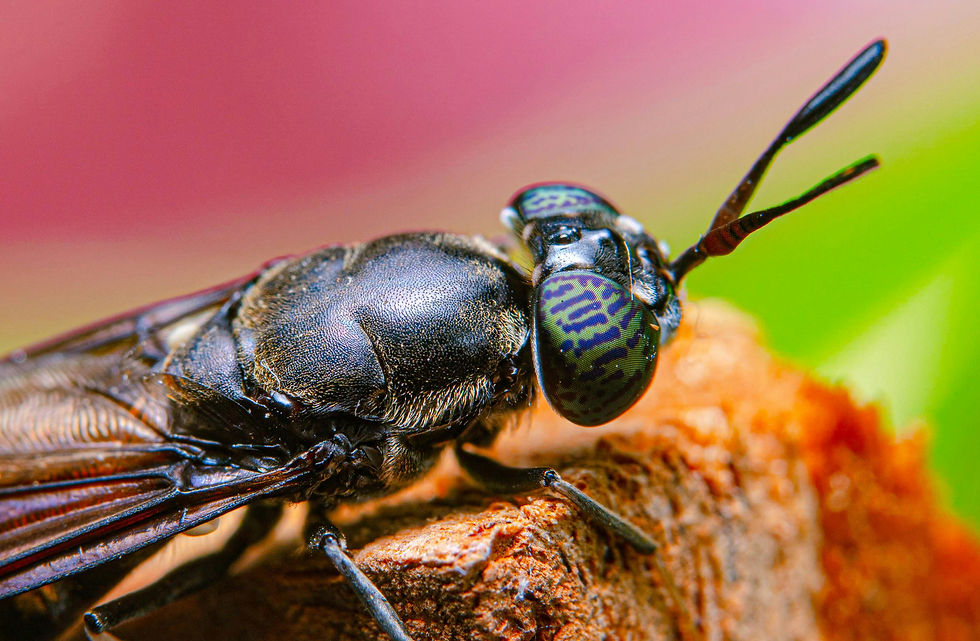
Conventional chitosan is largely sourced from crustacean shells, which are subject to seasonal variability and may carry shellfish allergens or heavy metal contaminants (Kumar et al., 2024). BSF larvae offer a scalable alternative: reared year round on organic side streams, their pupal shells contain 25 to 35% chitin that can be deacetylated to chitosan with the same backbone as marine-derived material, with lower residual mineral content and no shellfish allergen concerns. Controlled BSF farming enables tight process control over molecular weight distributions and DDA values that strongly influence viscosity, gelation behaviour, degradation and mechanical properties of chitosan bioinks (Kumar et al., 2024; Sahranavard et al., 2020). Entoplast's BSF-based production platform links organic waste inputs to standardised lots of chitin and chitosan through a circular, traceable supply chain, supported by technical documentation suited to regulated sectors including medical devices and regenerative medicine.
Conclusion
Chitosan bioinks provide a powerful toolkit for addressing the unique mechanical and biological challenges of cartilage and tendon repair. Their GAG-like chemistry supports chondrocyte and tenocyte compatibility, their mechanics and degradation can be finely tuned via crosslinking and compositing, and their functional groups enable sophisticated delivery of growth factors that drive tissue-specific regeneration (He et al., 2020; Ching et al., 2021; Hu et al., 2023). Although current evidence is largely pre-clinical, converging advances in bioink chemistry, anisotropic printing and cell manufacturing point towards a realistic pathway for chitosan-based, patient-specific musculoskeletal grafts.
Entoplast's high-purity, BSF-derived chitosan is engineered as a robust, sustainable raw material for these demanding applications, with specification control and documentation tailored to biomedical R&D and medical device development. Orthopaedic and sports medicine researchers, biomedical engineers and regenerative medicine companies exploring cartilage and tendon bioprinting are invited to partner with Entoplast for bioink formulation support, BSF chitosan specifications and comprehensive technical data packages.


Comments