


Decentralised Water Treatment: Chitosan for Rural and Off-Grid Communities
- Entoplast

- 1 day ago
- 8 min read

Decentralised, point-of-use (POU) systems are now essential to closing the global rural water access gap, and chitosan offers a rare combination of coagulation, antimicrobial action, and contaminant adsorption that fits low-cost, low-infrastructure treatment in off-grid settings. Entoplast’s Black Soldier Fly (BSF)-derived chitosan adds a circular, locally scalable raw material to this toolkit, aligning technical performance with sustainable WASH and development goals.
Global water access and disease
In 2024 an estimated 2.2 billion people still lacked safely managed drinking water services, 3.4 billion lacked safely managed sanitation, and 1.7 billion lacked basic hygiene at home, with rural communities disproportionately affected. Unsafe water, sanitation and hygiene are linked to roughly 1.4 million deaths annually, including hundreds of thousands from diarrhoeal disease, which remains a leading cause of illness and death in young children in low‑ and middle‑income countries (LMICs) (Bartram et al, 2023, WHO/UNICEF JMP, 2023).
These burdens are concentrated in rural, remote and fragile contexts where piped, treated water networks are absent or unreliable, and where women and girls often bear the time and safety costs of water collection (WHO/UNICEF JMP, 2023).
Limits of centralised infrastructure

Conventional centralised treatment and piped distribution depend on high capital investment, grid electricity, skilled operators and long-term institutional maintenance – conditions rarely met in sparsely populated rural or peri‑urban settlements. Gravity-fed rural schemes and small town networks frequently face breakdowns due to pump failure, poor cost recovery, and lack of spare parts, leading to intermittent or unsafe supplies even where infrastructure exists (Oxford Review, 2020).
Top‑down expansion of large utilities also struggles in disaster or conflict settings, where damaged networks, insecurity and displacement make rapid restoration of centralised services impractical (Bartram et al, 2023).
Why decentralised POU treatment matters
Decentralised POU and small community systems treat water at or near the point of consumption, reducing exposure to re‑contamination in transport and storage. Technologies such as ceramic and biosand filters, chlorination, and solar disinfection have demonstrated substantial reductions in thermotolerant coliforms (1–7+ log₁₀) and diarrhoeal disease in controlled studies, at costs ranging roughly from 0.08–12.3 EUR m⁻³ of treated water depending on technology and context (Tahir et al, 2015, Sobsey, 2009, Household POU Review, 2009).
However, many existing POU options either provide limited turbidity and pathogen removal (e.g. SODIS in very turbid water), lack residual protection (filters without disinfectant), or do not address geogenic contaminants such as arsenic and fluoride that are common in many rural aquifers. Integrating chitosan into these systems directly targets these gaps while preserving low-energy, low‑infrastructure operation (Sobsey, 2009, Tahir et al, 2015).
Chitosan’s multi-functional properties
Chitosan is a cationic biopolymer derived from chitin and is widely recognised as abundant, biodegradable, and non‑toxic, with strong affinity for negatively charged particles and many dissolved ions. In water treatment it offers four key functional roles particularly relevant to decentralised use:
Natural coagulant–flocculant: Protonated amino groups bind suspended colloids, natural organic matter and many microorganisms, promoting rapid aggregation and sedimentation without complex dosing equipment (Abebe et al, 2016, Jeon et al, 2020).
Antimicrobial action: Chitosan’s polycationic chains disrupt microbial cell membranes, inhibit biofilms and can inactivate a broad range of bacteria and fungi; activity has been shown against E. coli, Staphylococcus aureus and other pathogens, including in established biofilms (Orgaz et al, 2011, Jeon et al, 2020).
Heavy metal and anion adsorption: Amino and hydroxyl groups chelate metals such as lead and cadmium and interact with oxyanions such as arsenate and fluoride; modified chitosan sorbents reach arsenic capacities up to tens of mg g⁻¹ and can reduce groundwater arsenic to below 10 µg L⁻¹ in column operation.(Ayub & Raza, 2021, Kumar et al, 2013)
Biodegradability and safe sludge: As a biopolymer, chitosan-based sludges are more compatible with land application or co‑composting than alum- or PAC-based sludges, reducing the need for hazardous waste infrastructure (JMBFS, 2021).
These mechanisms operate at ambient temperature and can be harnessed in gravity‑driven or batch systems with minimal moving parts, making chitosan particularly suited to off‑grid communities.
Point‑of‑use formats using chitosan
A growing body of work demonstrates how chitosan can be embedded into simple POU configurations:
Chitosan pretreatment plus ceramic filters: Using chitosan as a coagulant before porous ceramic household filters has achieved 4.7–7.5 log₁₀ removal of E. coli and 2.8–4.5 log₁₀ removal of MS2 virus surrogates, with final turbidity consistently <1 NTU – well within WHO guideline values (Abebe et al, 2016).
Chitosan‑coated sand and granular filters: Chitosan- or iron–chitosan‑coated sand achieves Langmuir adsorption capacities around 17–23 mg g⁻¹ for arsenite and arsenate at pH 7, and can polish naturally contaminated groundwater to <10 µg L⁻¹ in column systems, while also removing turbidity and pathogens (Kumar et al, 2013).
Hydrogel beads and packed columns: Chitosan beads and hybrid chitosan–clay adsorbents can remove up to ~98 % of fluoride at low initial concentrations, with effective operation near neutral pH and regeneration for at least 3–5 adsorption–desorption cycles with only moderate loss of capacity (Senthilkumar et al, 2019).
More advanced formats widen the design space:
Chitosan‑impregnated ceramic or polymer membranes: Chitosan–ceramic and chitosan–polymer composite membranes demonstrate combined size‑exclusion, adsorption, antimicrobial and, when coupled with photocatalysts, visible‑light‑driven degradation of organic pollutants and microbes (PMC, 2022).
Aerogels and composite adsorbers: Chitosan-based aerogels offer extremely high porosity and surface area for adsorption of dyes, metals and microbes, while remaining lightweight and biodegradable – promising for modular cartridges in gravity-fed devices (RSC Advances, 2025).
Solar-assisted photocatalytic systems: Chitosan/TiO₂@g‑C₃N₄ nanocomposite membranes have achieved >90 % removal of multiple pollutants (dyes, atrazine, Cr(VI)) under visible light at ambient conditions, with no loss of activity over at least 10 cycles, illustrating the potential for low‑energy, solar‑activated multi‑barrier POU systems (Zhang et al, 2021).
Together, these formats span household, shared community and small‑institutional uses as well as portable and emergency devices.
Performance benchmarks versus conventional POU methods
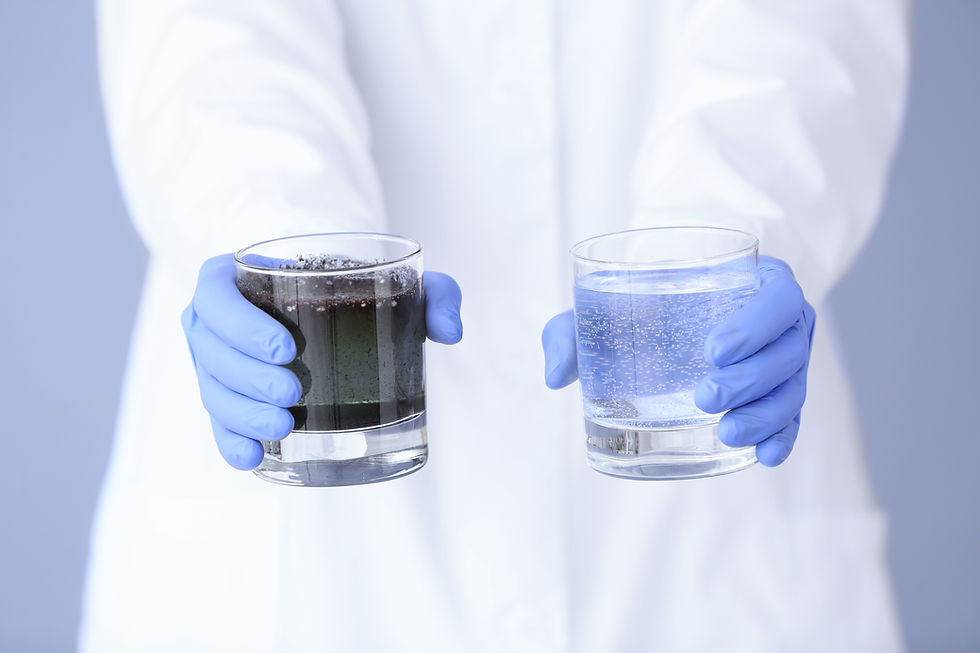
Chitosan-enhanced systems can match or exceed the microbiological performance of many conventional POU options while adding turbidity and inorganic contaminant control:
Turbidity and bacteria: Chitosan coagulation plus ceramic filtration routinely delivers ≥4–7 log₁₀ E. coli removal with final turbidity <1 NTU, placing such systems in the “comprehensive” or “highly protective” range of the WHO HWT performance scheme when correctly used (Abebe et al, 2016).
Viruses and protozoa: While plain ceramic and biosand filters often show 0–2 log₁₀ virus removal, pre‑coagulation with chitosan significantly improves virus and protozoa capture by forming larger, denser flocs that are retained in the filter bed (Sobsey, 2009, Abebe et al, 2016)
Heavy metals and fluoride: Chitosan-based sorbents such as hydroxyapatite–chitosan (HAP‑CTS) nanocomposites achieve breakthrough capacities of approximately 3000, 3000, 2600 and 2000 mL g⁻¹ for Pb(II), Cd(II), As(V) and fluoride respectively in gravity-fed columns treating realistic rural groundwater concentrations (Fernando et al, 2021).
By contrast, boiling and SODIS are effective for pathogens but do not remove arsenic, fluoride or turbidity and depend on fuel or strong sunlight; chlorine is inexpensive and provides residual protection but is less effective in very turbid water and does not remove metals. Chitosan is therefore best viewed as a powerful pre‑treatment or integrated medium within multi‑barrier systems combining coagulation, filtration and (where needed) disinfection (Household POU Review, 2009, Sobsey, 2009).
Economics, maintenance and community operation
Chitosan-based systems are compatible with community‑managed models because they minimise moving parts and energy use while using replaceable, regenerable media. Dry chitosan powders and beads are chemically stable when stored in sealed containers away from moisture and can be shipped in bulk, with dosing implemented via simple spoons or pre‑packed sachets, avoiding complex pumps or dosing pumps used for alum or PAC.
Studies of chitosan–based adsorbents show that many formulations can be regenerated 3–5 times using alkaline or saline solutions, or are designed as single‑use low‑cost media embedded in filters; either model can be cost‑competitive with ceramic or biosand filters when amortised over their service life. Training requirements focus on a few key behaviours – correct mixing/settling time, regular filter cleaning, and safe disposal or reuse of spent media – which can be incorporated into existing community WASH training platforms.
Humanitarian and disaster relief use
Emergency responses often rely on sachet‑based coagulation–flocculation–disinfection products or powdered alum/PAC plus chlorine, which can be highly effective but generate aluminium-rich sludge and require careful handling of oxidants. Chitosan-based coagulation sachets offer a biodegradable, low‑toxicity alternative that can be dosed by volume into buckets or jerrycans, forming visible flocs that settle quickly before decanting through cloth or low‑cost filters (AIDIC, 2014, Tahir et al, 2015, Household POU Review, 2009).
Because chitosan is non‑toxic to mammals and derived from biological feedstocks, sludge volumes can often be co‑disposed with organic solid waste or latrine sludge, reducing hazardous waste management needs in constrained field settings. Chitosan–photocatalyst membranes and portable cartridges can also complement trucked or bottled water by providing on‑site polishing of stored supplies, particularly where intermittent contamination is a concern (Zhang et al, 2021, JMBFS, 2021, PMC, 2022).
BSF-derived chitosan and the circular economy

Traditionally, commercial chitosan has been sourced from shrimp and crab waste, tying supply to fisheries and generating marine-sourced organic residues; insect-derived chitosan offers a newer, potentially more sustainable pathway. Black Soldier Fly (BSF, Hermetia illucens) larvae and puparia raised on organic agricultural and food processing residues can yield chitin contents of roughly 20–35 % by dry weight, which can be converted to high‑quality chitosan with degrees of deacetylation and purity comparable to crustacean products.
Recent reviews show that insect-derived chitosans (including from BSF) match or exceed crustacean chitosan in antimicrobial activity, adsorption capacity and mechanical properties, while enabling year‑round production in controlled facilities and reducing reliance on seasonal marine by‑products. This underpins a circular model: organic waste → BSF biomass → chitin/chitosan → water purification media → biodegradable sludge and, where appropriate, nutrient recycling back to agriculture.
Entoplast’s role and BSF sourcing advantage
By producing BSF-derived chitosan in a controlled UK facility, Entoplast can offer WASH implementers a consistent, traceable product with tailored molecular weight and deacetylation levels optimised for coagulation, adsorption or composite fabrication. Technical teams can draw on the growing scientific evidence base for chitosan in ceramic filters, coated sands, aerogels, photocatalytic membranes and emergency sachets when designing decentralised treatment trains for rural and off‑grid communities.
In parallel, Entoplast’s focus on BSF supports the longer‑term goal of establishing in‑country BSF production in tropical LMICs, enabling local chitosan manufacture from agricultural residues and reducing dependence on imported alum, PAC or crustacean chitosan. This creates opportunities for integrated livelihoods and waste‑to‑resource value chains alongside WASH investments.
Conclusion and call to action
Chitosan brings together natural coagulation, broad-spectrum antimicrobial action, and strong affinity for metals and oxyanions in a single, biodegradable material that can be deployed through gravity-fed filters, sachets, composite membranes and solar-assisted systems without dependence on grid power or complex infrastructure. For rural and off‑grid communities facing both microbial and chemical contamination, chitosan-based multi‑barrier POU systems offer a credible path to WHO‑aligned performance at modest cost and with community‑level operation and maintenance.
BSF-derived chitosan reinforces this technical case with a circular, potentially locally producible feedstock that aligns with sustainable agriculture, solid waste management and climate‑resilient development strategies.
Entoplast welcomes collaboration with WASH NGOs, humanitarian agencies, development banks and off‑grid infrastructure developers to co‑design chitosan-based solutions for specific geographies and contaminant profiles. To obtain BSF chitosan specifications, performance data, and support for programme design and field pilots, please contact Entoplast’s technical team.


Comments